


Renewing the West: Romano Guardini, Christian Humanism, and the Spe Salvi Institute
Updated: Jan 2
Sometimes, we only truly grasp what we're pursuing in the very act of pursuing it. Recording the Spe Salvi Institute podcast has helped me better understand and articulate what Andrew and I are building with the Institute. What begins as a faint seed of an idea gradually unfolds and matures over time.
Looking back over our many conversations this year, it is clear that we are reaching for something deep beneath the surface: the foundations and destiny of the world we inhabit. We are not content merely to analyze the present moment; instead, we try to zoom out as far as possible to discern the larger vision of reality—the Weltanschauung—into which we have been formed and which we often take for granted as naturally as the air we breathe.
It would be a mistake to imagine that we make pretensions to approach the contemporary world from some neutral, Archimedean vantage point. At the deepest level, we are seeking the truth of reality in and through the form of Jesus Christ. This impulse echoes Hans Urs von Balthasar's great project of renewal through adoring contemplation of the Gestalt of Christ. It lies at the heart of the Christian humanism that Andrew and I keep returning to—and that we believe is essential for any genuine renewal in the West.
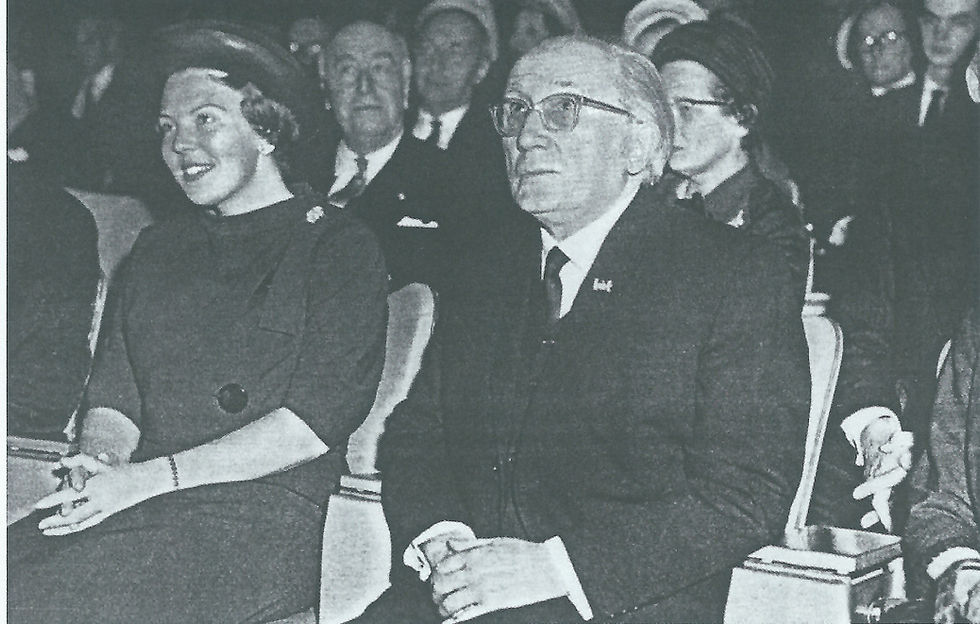
One figure who has shaped me profoundly is Romano Guardini (1885-1968), perhaps one of the most important Catholic intellectuals of the twentieth century. I encountered him early, almost by accident, when my mother—unaware of his depth—bought his The Art of Prayer for the family. The chapter “The Reality of God and the Basic Acts of Prayer,” in which Guardini presents God not as a distant concept but as the supremely personal Thou who is more intimately present than we are to ourselves, changed my life. Such an encounter quietly transforms one's vision and experience of everything over time and gives rise to a distinct vision of the world.
Lately, I've been thinking about Guardini constantly in light of what Andrew and I are doing with the Institute. Guardini knew a thing or two about being an authentic Christian in the modern world. His professorial chairs at Berlin, Tubingen, and Munich were in Philosophy of Religion and Christian Weltanschauung. I believe we are continuing his exploration of a distinctly Christian Weltanschauung. As Max Scheler once urged Guardini: “You must look at things, people, the world—but do so as a responsible Christian, with a view to articulating scientifically what it is you see.” That is precisely what we are attempting: to engage reality through the Word through whom “all things were made” (John 1:3). As noted above, we make no pretense of neutrality—a fantasy, as Charles Taylor has shown, since every self is always already situated within a particular story of reality. We offer no apologies for seeing the world from our concrete, living position within the Church. Nor do we think we are forcibly fitting the world to an arbitrary standard (in this case the Word) like Procrustes and his bed.
This perspective also explains our focus on Europe. Guardini himself was deeply preoccupied with Europe's past, present, and future, living as he did through the catastrophic conflicts of the nineteenth and twentieth centuries—sometimes called the “European Civil War.” Like Erich Przywara and others, Guardini insisted that Europe could have a future only through a renewed Christian humanism. He made this point forcefully in his 1962 acceptance speech for the Erasmus Prize: Europe arose from a Christian Weltanschauung, and if it abandons that vision it will become something altogether different. Disciples of Guardini—Pope John Paul II, Pope Benedict XVI, and even Pope Francis (who once planned a dissertation on Guardini)—have repeatedly stressed this vital connection. Many Americans still recognize it, and perhaps Americans like Andrew and me are now required to help Europeans rediscover their own Christian heritage.
Finally, Guardini's work is not limited to description. He actively sought to form people in this Christian vision of reality and experience the fullness of life. Many of his books are practical guides for cultivating the inner disposition needed to receive the truth—who is ultimately God himself. He wrote on the virtues, on preparing for Mass, on the art of prayer. Becoming like God through cooperation with grace in the living Church does not happen by accident; we need guides and mentors such as Guardini along the way.
My hope is that the Institute can offer exactly this kind of formation by creating environments that foster the life of prayer. Benedict XVI called prayer a “school of hope” in Spe Salvi, the great encyclical that we have chosen as our project’s namesake. I see the Institute's educational endeavors—even something as seemingly simple as a guided tour of a European city—as a school of hope, because as a condition of seeing the city we will cultivate the capacity to truly see. And how can one really see a city without reverence? Remarkably, these European cities were themselves designed, in large measure, to cultivate just such reverence—and thus to dispose the soul to encounter God, our beginning and end, much as I first encountered him years ago while reading Guardini on the reality of God in The Art of Prayer.
In 2026, we hope to continue to explore all things in the spirit of Guardini and other humanist Christians influenced by Guardini, like Hugo Rahner who wrote in his profound book Greek Myths and Christian Mystery:
"For the humanist Christian there is only one possible attitude that he can take towards the world: he must love. Yet one can only love a person, and that is why the Christian humanist loves the human in every shape and form but only in him whom St. Paul says, 'all things were created in him' (Col. 1:17)."
by Robert Mixa


Comments