


True Sons of Liberty: Remembering the foreign-born heroes of the American Revolution
Updated: Jul 23
Growing up near Chicago, my earliest acquaintance with the name Pulaski came from an annual school holiday. Like most kids in Illinois, I simply enjoyed having the day off on Pulaski Day, and spent much of my youth driving up and down Pulaski Avenue without giving it a second thought. It was not until I met my wife, and became involved through her with Chicago's vibrant Polish-American community, that I actually began to learn about the man behind the street signs.

Many European volunteers came to the aid of America during the Revolutionary War, believing in the righteousness of the colonial cause while also looking for an opportunity to serve. Famous figures from across the continent—such as the Marquis de Lafayette, the Comte Jean de Rochambeau, Baron Friedrich Wilhelm von Steuben, and Pierre Charles L'Enfant—were famously recruited by Benjamin Franklin in Paris. Yet, among these luminaries, Franklin also encountered two Polish freedom fighters living in exile from their Polish-Lithuanian homeland. They had been forced to flee after fighting against the violent partitioning of their country by three neighboring authoritarian regimes: Casimir Pulaski and Tadeusz Kościuszko. While both men remain deeply revered within patriotic Polish-American circles, they are far less known among the broader American public today, despite their monumental contributions to the founding of the United States.
Pulaski’s journey to America was a response to the turmoil of European geopolitics. As a nobleman and the son of one of the founders of the Bar Confederation—a movement formed in the mid-18th century to prevent Russia from turning the Polish-Lithuanian Commonwealth into a puppet state under King Stanisław August Poniatowski—Pulaski grew up seeking Polish independence. After partaking in a plot to kidnap the puppet king, Pulaski was forced to flee Poland under the trumped-up accusation of attempted assassination. At the time, France served as a safe haven for many freedom-loving Poles. It was there in exile that Pulaski connected with Benjamin Franklin, finding himself deeply inspired by the American struggle. He carried with him the spirit of the old Polish motto, "For your freedom and ours"—a philosophy dictating that the fight for liberty anywhere is a fight for liberty everywhere. But he also needed a job.
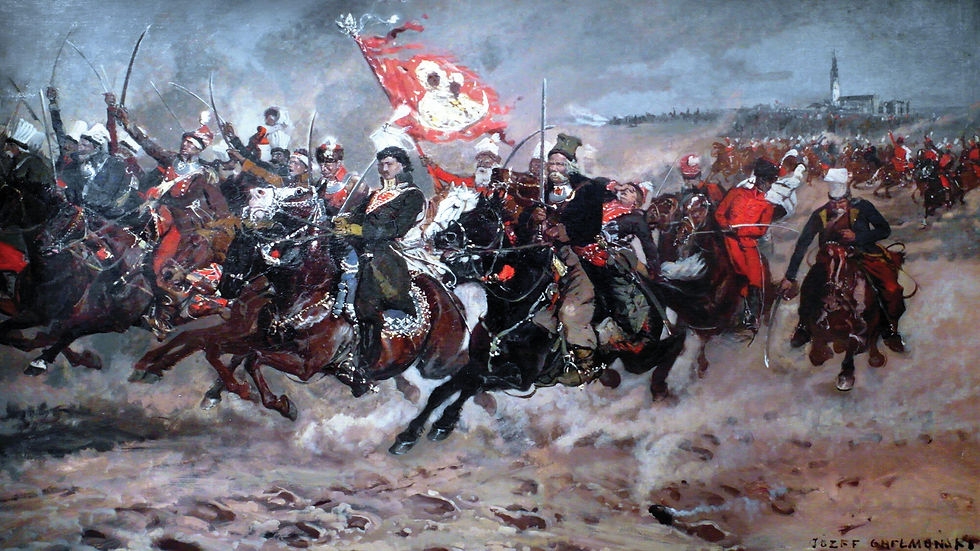
Upon arriving in America, Pulaski proved invaluable. Like many European recruits, he brought specialized military expertise, specifically helping to train the Continental Army in cavalry tactics, an area where Poland and its famous winged Hussars excelled. Accordingly, Pulaski became known as the "Father of the American Cavalry". He was elevated to Brigadier General following his strategic genius at the Battle of Brandywine, where his swift and daring counterattack famously saved George Washington's life. Tragically, Pulaski’s American journey was cut short. He died at the young age of 34 from a gunshot wound inflicted during a bold charge at the Siege of Savannah, never able to return and rescue his own struggling commonwealth.
My first encounter with the second of these Polish heroes, Tadeusz Kościuszko, also occurred during my childhood in Chicago, where I remember seeing his statue on the museum campus by the lakefront. As a kid, I could not pronounce his name, and to this day, I still struggle to spell it.
Like Pulaski, Kościuszko came from a noble family in the Polish-Lithuanian Commonwealth. His family was likely Ruthenian in origin but had been Polonized in the 16th century, living in a region of Poland that is today part of Belarus. Although educated at Warsaw's School of Chivalry under the patronage of the Polish king and the famous aristocratic Czartoryski family, Kościuszko had to flee his country after siding with his brother, who was actively fighting for the Bar Confederation against the king and those who favored a collaborative approach with Russia.
Kościuszko eventually ended up in Paris on a scholarship, studying art and architecture—disciplines he would later apply to designing American fortifications along the Delaware River, Saratoga, and West Point. He eventually arrived in Philadelphia after nearly drowning in the Caribbean when his ship was caught in a severe storm. Recognizing his talent, Benjamin Franklin took him under his wing and recommended him to the Second Continental Congress.
George Washington first met Kościuszko at West Point in 1778. Recognizing his tactical brilliance, Washington personally selected Kościuszko to design and build the critical fortifications along the Hudson River. Washington frequently praised his work and capability to Congress, eventually resulting in Kościuszko being named a brigadier general and honored with the prestigious Society of the Cincinnati medal.
Long before the two men finally met in person during Kościuszko's second American exile in 1797, the Polish engineer deeply admired Thomas Jefferson's Declaration of Independence. Forced back to America by the failure of his 1794 uprising against Russia and the watchful eyes of European spies, Kościuszko found a kindred spirit in Jefferson. Jefferson admired Kościuszko's intellect and heroic idealism, and the two spent long hours discussing the worrying radicalism of the French Revolution, the emerging threat of an authoritarian and elitist U.S. government, and the destruction of Poland by tyranny.
Yet, while the two maintained a warm friendship, Kościuszko actively challenged Jefferson on the hypocrisy of proclaiming universal freedom while keeping human beings enslaved. Kościuszko even appointed Jefferson as the executor of his will, stipulating that his American estate be used to free and educate Jefferson's slaves. Upon Kościuszko's death in 1817, Jefferson officially recused himself from the duty. While Jefferson wrote one of the foremost documents expressing the ideals of the Enlightenment and kept a twenty-year correspondence discussing them with his Polish friend, Kościuszko actually lived them. Jefferson recognized this moral purity, writing of his friend, "He is as pure a son of Liberty as I have ever known."

Decades later, this profound legacy would clash with modern historical amnesia. During the 2020 George Floyd protests, demonstrators targeted and defaced the Kościuszko statue standing in Lafayette Square in front of the White House, unaware that one could scarcely find a more dedicated enemy of slavery anywhere else in the world during his time.
Although Kościuszko was baptized and raised Catholic, he, in all likelihood, did not abide by the precepts of the Church. He did not have a very good relationship with the church hierarchy. And while he did state in his oath at the Main Market Square in Krakow in 1794 that he swears before God, ending with, "So help me God and the innocent Passion of HIs Son", he became more radical after the failed insurrection, subscribing to anticlericalism and and blaming the Church for the continuation of feudalism and the serfdom of the peasants. He thought that the clergy took advantage of people's ignorance and the power that came from their close relationship with secular authorities. His ideal was that of a secular state with the Catholic Church reduced to the role of Christian denominations with no prominent role in education. This maybe the outgrowth of an ascendant rationalism and political liberalism of his time.
In a way, Kościuszko embodies the problematic nature of the founding of America for Catholics. In the past decade, some American Catholic intellectuals have debated whether or not there was an "anti-Catholic" dimension to the liberal founding of America. I think such debates are important and not to be dismissed as unpatriotic or playing into the hands of the despisers of America. Listeners to our podcast will know that I am sympathetic to the Communio postliberal reading of the American founding. How that affects my reading of Kościuszko is not all that clear. Kościuszko was a man of his times, a man of the Enlightenment. Perhaps his understanding of universal liberty could have had a better metaphysical foundation in keeping with the Christian faith. Nevertheless, we should admire the man and his contributions to the founding of America without wholesale condemnation.
As we celebrate the 250th anniversary of American independence, may we remember not just those courageous souls from the American colonies, but also the ones who, though foreign-born, were true sons of liberty, albeit a freedom needing its completion in Christ. And if you ever find yourself in Washington, D.C., take a moment to visit the statues of Pulaski and Kościuszko. They stand as enduring monuments to a deep, historic bond between Poland and America that dates back to our very entry onto the world stage.


Comments